
Feet and Inches Calculator
Add, subtract, multiply and divide lengths in feet, inches and fractions. The answer comes back the way a tape reads, and in decimal feet and metric.
20' 6-1/2" + 1' 3-3/4"
21' 10-1/4"
262.25 in · 6.6612 m
- Feet and inches
- 21' 10-1/4"
- Inches
- 262-1/4"
- Decimal feet
- 21.8542 ft
- Decimal inches
- 262.25 in
- Yards
- 7.2847 yd
- Metres
- 6.6612 m
- Centimetres
- 666.12 cm
- Millimetres
- 6,661.1 mm
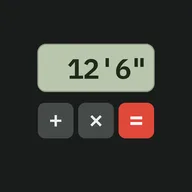
A feet-inch keypad in your pocket
Kalku is built around this: type 20 Feet 6 Inch 1/2 on a real keypad and keep going, chain as many steps as you like, store results in memory and convert any answer with one key. Length × length becomes an area and area × length a volume, on its own. Coming to iPhone and Android, free with no ads.
How the arithmetic works
Both lengths are turned into inches, the operation is done on the inches, and the answer is turned back into feet, inches and a fraction at the end. Only that last step rounds: the fraction is rounded to the nearest 1/16 inch (or whatever you pick) and reduced, so 8/16 reads 1/2, and a fraction that rounds up to a whole inch carries into the inches and on into the feet rather than printing 6-16/16". This is the display logic of the Kalku app, ported line for line.
The kind of answer follows the dimensions, as in the app. A length plus or minus a length is a length. A length times a length is an area. A length divided by a length is a plain number, how many times one fits into the other. A length times or divided by a plain number stays a length.
Worked example
The calculator opens on 20' 6-1/2" + 1' 3-3/4". In inches that is 246.5 + 15.75 = 262.25, which is 21 feet (252 inches) and 10.25 inches: 21' 10-1/4". In decimal feet it is 21.8542, and in metres 6.6612. Switch the operation to ÷ and the second length to 16 inches, and the first length holds 15 whole 16 inch spaces with 6-1/2 inches left over.
Inch fractions in decimals and millimetres
| Fraction | Inches | Millimetres |
|---|---|---|
| 1/16" | 0.0625 | 1.59 |
| 1/8" | 0.125 | 3.17 |
| 3/16" | 0.1875 | 4.76 |
| 1/4" | 0.25 | 6.35 |
| 5/16" | 0.3125 | 7.94 |
| 3/8" | 0.375 | 9.52 |
| 7/16" | 0.4375 | 11.11 |
| 1/2" | 0.5 | 12.7 |
| 9/16" | 0.5625 | 14.29 |
| 5/8" | 0.625 | 15.88 |
| 11/16" | 0.6875 | 17.46 |
| 3/4" | 0.75 | 19.05 |
| 13/16" | 0.8125 | 20.64 |
| 7/8" | 0.875 | 22.22 |
| 15/16" | 0.9375 | 23.81 |
Questions
How do you add feet and inches?
Add the inches first, carry every 12 inches into a foot, then add the feet. 20' 6-1/2" + 1' 3-3/4": 6-1/2 + 3-3/4 = 10-1/4 inches, and 20 + 1 = 21 feet, so 21' 10-1/4". The calculator does it the way the Kalku app does: it turns both lengths into inches, adds them, and turns the answer back into feet, inches and a fraction.
How do I convert decimal feet to feet and inches?
The whole number is the feet. Multiply what is left by 12 for the inches, and the remainder of that by 16 for sixteenths. 20.54 feet is 20 feet and 0.54 × 12 = 6.48 inches; 0.48 × 16 = 7.68, which rounds to 8/16, so 20' 6-1/2". Type 20.54 into the feet box and set the second length to zero to see it.
What does multiplying two lengths give?
An area. 20 feet × 12 feet is 240 square feet, not a length, so the calculator shows it in square feet, square inches, square yards and square metres. To scale a length instead, choose a number: 20' 6-1/2" × 2 is 41' 1".
What does dividing one length by another tell me?
How many times the second fits into the first, which is the question behind every layout: how many 16 inch spaces in a 20 foot wall (exactly 15), how many 8 foot boards along 30 feet. The calculator gives the exact figure, the whole pieces and what is left over. To split a length into equal parts, divide by a number instead.
Which fraction should I round to?
Sixteenths are what most tape measures mark and what framing works to, so that is the default, as in the app. Finish carpentry may want 1/32; rough work is fine at 1/8. Rounding is only for display: the arithmetic keeps every decimal, so rounding never adds up across several steps.


